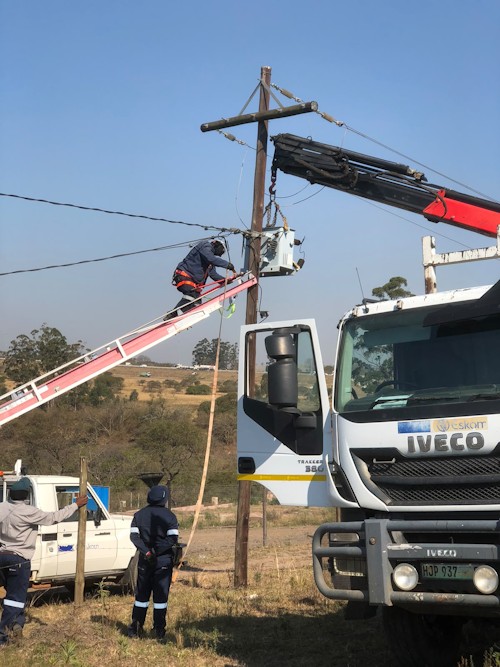
 Today, Eskom is in Lion Park, Pietermaritzburg, removing illegal electricity connections, following several engagements with the relevant stakeholders that failed to produce a mutually acceptable resolution to the matter.
 Over the past twelve years, the Lion Park community has grown to over 1 400 households. The area consists largely of high Socio-Economic Measure (SEM) households with the capacity to pay for services. The properties have been developed on land that was redistributed and is administered by a Community Trust.
Members of the community have constructed extensive illegal electricity infrastructure, including poles, lines and transformers, to supply power to approximately 1 400 households. This illegal network taps into the adjacent Eskom electricity networks. The unauthorised connections are estimated to result in revenue losses exceeding R14 million per year to Eskom. In addition, portions of the illegally installed infrastructure are suspected to have been obtained illegally.
Eskom reiterates that it has a legal obligation, in terms of its electricity distribution licence and the NRS 048 Code, to remove illegal connections and ensure the safe and reliable supply of electricity to all customers. Illegal connections place significant strain on the electricity network, increase the risk of outages, and pose serious safety hazards to communities.
Approximately 6 months ago, Eskom offered a temporary solution by proposing a bulk electricity supply point at the boundary of the Trust Land. This was not accepted by the Trustees and Community. Eskom required a deposit in order to proceed with construction and the provision of a bulk supply. The long-term solution remains the formal zoning of the land, as well as the planning and implementation of electrification since the land is currently not zoned for residential development.
On 4 June 2026, Eskom was served with an urgent application for an order interdicting the impending operation. The application was brought by a group of individuals alleging to be residents of Lion Park. Eskom entered its intention to oppose the order. On 5 June 2026, the Pietermaritzburg High Court struck the matter off the roll and awarded costs in favour of Eskom.
Eskom remains committed to providing electricity services in a lawful and safe manner. As such, illegal connections must be removed because thyy threaten the integrity and safety of the electricity network. Furthermore, Eskom is required under its licence conditions to collect revenue for electricity supplied through its networks.
The CentralEast General Manager, Kevin Pillay, is fully behind this operation. He remarked that the Eskom Chairman, Dr Mteto Nyati summed it up well when he said, “South Africans deserve reliable electricity, but that future can only be built on a foundation of accountability and payment for services rendered. Non-payment by municipalities and customers isn’t just a financial issue - it is holding back our nation’s progress, investment, and prosperity. We have made significant strides
in stabilising the grid, but sustainable success demands collective responsibility. Let us commit to a culture of integrity and payment discipline. When we all pay what we owe, we power a stronger, more reliable South Africa for every citizen and business.”
Eskom is grateful for the support rendered by the South African Police Service and Eskom security teams in removing the illegal connections. Similar operations will be carried out throughout the province in areas rife with illegal connections.
Eskom Group Investigations and Security General Manager, Tembela Kulu, added that the organisation remains committed to protecting Eskom infrastructure and networks. “Being part of this operation demonstrates our seriousness in protecting our assets. Our teams will continue to support the audit and removal of illegal connections to safeguard Eskom’s assets; protect the integrity of the electricity network; and safeguard our employees’ safety.”
While managing electricity losses through the identification and removal of illegal connections is costly, the greater cost to society is the risk to human life. Illegal connections frequently lead to electrocutions, fires and damage to critical infrastructure.
Eskom urges members of the public to report illegal activity, including electricity sales, fraud, equipment theft, meter tampering and other electricity-related crimes to the Eskom Crime Line on 0800 11 27 22, via WhatsApp on 081 333 3323, via email at This email address is being protected from spambots. You need JavaScript enabled to view it. or via SMS Line on 31090. Reports can be made anonymously.
Supplied.