 Coming up at MiTH this week...
9pm - Tantu Nada is an acoustic world/fusion duo comprised of Dave Starke (guitar and vocals) and Nish Pillay (tabla and percussion). They create a unique East-meets-West eclectic sound.
Drawing on various genres including Jazz, Latin, Reggae, Rock and Pop and blending them with the rhythms of the Indian subcontinent, they create a stylish musical pairing that manages to feel familiar and yet still fresh and exciting.
Dave is an accomplished entertainer with over 20 years’ experience in the music industry. He has performed at The National Arts Festival , The Hilton Arts Festival and White Mountain Music Festival. In 2017, he was a contestant in the first season of The Voice South Africa.
Nish studied percussion in both South Africa and India and has performed with many of South Africa’s finest musicians both live and in the studio. He was a contestant on the 2017 season of SA’s got talent and his festival appearances include Splashy Fen, White Mountain Music Festival, The National Arts Festival and The Michaelhouse Festival of Music.
Their partnership dates back to 2017 when they first started performing together across KwaZulu-Natal, and since then their repertoire has grown and developed to include music from a wide range of eras and genres.
8pm - Fishwives
The Fishwives were born out of late-night, side-street jam sessions during the National Arts Festival, 2013. Consisting of Celery Burger, Lizzie-Lou Gaisford and Strato Copteros, they have performed on festival stages across the country and been noted for bringing a highly unique flavour to the current South African scene. Songs flow seamlessly from a low tide of alternative folk to a high of progressive rock, with iconic vocal harmony, intricate instrumentation and narrative lyrics all present across this shore. Subject matter is both wickedly dark and wittily light; rabbit-holes of homegrown nostalgia, local superstition, soured suburban bliss and revenge in all its satisfaction. They have recently released their debut album, 'ALGAE', which has thus far been described as echoing an entire 70's record collection without trying to reproduce what was.
7pm - The The Freewheelers
The Freewheelers is a 5-piece band from Zululand with an eclectic sound. Join them on a musical journey that will whisk you to outer space before drawing you back to the heart of the African savannah. Take a trip with them to the heel-tapping, hat-tipping land of folk, before gliding your way through the smoke-filled halls of blues. Crossing the Tugela for the first time as a band, they come armed with a pelaton of instruments, covering big standards, a few edgy mash-ups and even a sample of their home-grown tunes. So, let go of the handlebars and freewheel along the road with this diverse group of musical legends.
Members:
Johan Gerber - vocals, guitar, harmonica
Dave Squires - bass guitar, vocals
Barbara Owen - violin
Vicky Erasmus - keyboard, cello, accordion, backing vocals
Craig Wilkinson - Saxophone
Johan Gerber - vocals, guitar, harmonica
Dave Squires - bass guitar, vocals
Barbara Owen - violin
Vicky Erasmus - keyboard, cello, accordion, backing vocals
Craig Wilkinson - Saxophone
Supplied by MiTH
 St Anne’s Diocesan College pupils received nine of the 27 prizes presented at the Douglas Livingstone Creative Writing Competition Prize Giving held at Westville Girls’ High on 17 September. Girls from Grades 10, 11 and 12 were awarded two 1st place prizes, one 2nd and six highly commended awards.
 The PADCA Mile is now in its SEVENTH year and has moved to a new venue,
  Laddsworth Grade 6 pupils took part in the BNP Paribas RCS Rising Stars Tennis Tournament in Westridge, Durban on Saturday 7 September 2019.
 Ilse Dippenaar, CEO.
 Congratulations to the following girls on their most recent President's Award achievements.
 Buy One Get One Free offer ...
 Drakondale Girls Choir are trying to gather 100 video CLIPS of people showing their support for the Bokke.
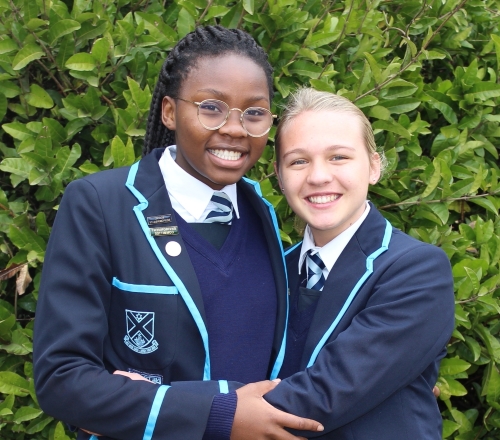 St Anne’s Diocesan College is proud to announce that Tsholofelo Mkhari has been named Head Girl and Ariné de Villiers Deputy Head Girl for 2020.
 The following girls from St Anne’s Diocesan College are representing KZN Inland Soccer for their respective age groups at a tournament in Johannesburg over the September holidays.
 Last week a group of Grace College Pupils celebrated Happiness Day by spreading joy to early morning commuters. The students handed out free packets of chips to people catching the taxis and busses nearby the Grace College Sports Gate.
 Each year, the Harcourts Hilton Open Midlands Gardens committee arranges something different for visitors to enjoy and this year, their theme is Majestic Trees of the Midlands as well as focusing on small gardens once again.
 The Firm Hilton's owner Leslie would like to sell her beautiful business to the right buyer.
 Come and celebrate this Saturday ,a Cool Winds Pre-Primary School Heritage Day Event.
 Bella Donna's Tracy Roberts, is officially an internationally qualified colour coding consultant! What does mean for you as a client??
 This September our local
 Laddsworth pupils Nicholas Kruger (Grade 7) and Patrick Lamb (Grade 6) took part in the Beavers Winter Championships Gala from 30 August to 1 September 2019 at Kings Park swimming pool in Durban.
 Like you, we love our community. We have a passion for Hilton and its people. Sadly, due to the current state of government and our municipalities, resources are limited to be able to maintain (and improve) the standards we would like Hilton to be at. The reality is that if we as businesses do not step in and help upgrade Hilton, our village as we know and love it, will deteriorate, property prices will plummet and business growth will decline as investor confidence and tourist numbers follow suit.